Showing posts with label truth. Show all posts

Monday, October 1, 2012

Happy Feast of St. Thérèse!


“May today there be peace within.

May you trust God that you are exactly where you are meant to be.

May you not forget the infinite possibilities that are born of faith.

May you use those gifts that you have received, and pass on the love that has been given to you.

May you be content knowing you are a child of God.

Let this presence settle into your bones, and allow your soul the freedom to sing, dance, praise and love.

It is there for each and every one of us.” 

--St. Thérèse

Friday, August 10, 2012

Go Forth and Read

"Female virginity has become entangled with a sickly, sentimental construction of passive femininity; a kind of chivalric purity that smells of heavy imitation rose perfume and requires a china doll untainted by passion, experience, or thought."

Entire post here.

Tuesday, February 7, 2012

Auntie Seraphic Does It Again

Have we mentioned yet how much we love Auntie Seraphic? No? Well, on a scale of line-dried sheets to Jane Austen, she's right below Jane Austen. By that much.

Nashville Dominicans' Novena

Current events are not our forte here, but this is something I think should be passed along. The Nashville Dominicans (Dominican Sisters of St. Cecilia) will be praying a novena from February 11-19 for our country in the light of the recent HHS mandate.


We beg God for the preservation of our great and beautiful country, and of the freedom we have all enjoyed and been privileged to share with others.  The Dominican Sisters of St. Cecilia invite you to join with us in a novena of prayer and fasting, asking Mary, Patroness of the United States of America, to implore God’s loving mercy on us at this critical time.  The novena will begin February 11 and end February 19, 2012.  The sisters will be praying the following prayer each of the nine days.

Act of Consecration of the United States to the Immaculate Heart of Mary
     Most Holy Trinity: Our Father in heaven, who chose Mary as the fairest of your daughters; Holy Spirit, who chose Mary as your spouse; God the Son, who chose Mary as your Mother; in union with Mary, we adore your majesty and acknowledge your supreme, eternal dominion and authority.
     Most Holy Trinity, we put the United States of America into the hands of Mary Immaculate in order that she may present the country to you.  Through her we wish to thank you for the great resources of this land and for the freedom, which has been its heritage. Through the intercession of Mary, have mercy on the Catholic Church in America.  Grant us peace.  Have mercy on our president and on all the officers of our government.  Grant us a fruitful economy born of justice and charity.  Have mercy on capital and industry and labor. Protect the family life of the nation. Guard the precious gift of many religious vocations. Through the intercession of our Mother, have mercy on the sick, the poor, the tempted, sinners – on all who are in need.
     Mary, Immaculate Virgin, our Mother, Patroness of our land, we praise you and honor you and give our country and ourselves to your sorrowful and Immaculate Heart.  O Sorrowful and Immaculate Heart of Mary, pierced by the sword of sorrow prophesied by Simeon, save us from degeneration, disaster and war.  Protect us from all harm.  O Sorrowful and Immaculate Heart of Mary, you who bore the sufferings of your Son in the depths of your heart, be our advocate.  Pray for us, that acting always according to your will and the will of your divine Son, we may live and die pleasing to God.  Amen.


On a related note: Cardinal-designate Dolan's WSJ Op-Ed piece.

Monday, January 23, 2012

Friday, June 18, 2010

Dangerous Women

My mother recently found this gloriously inspiring speech about the "Dangerous Christian Women" by Nancy Wilson and strongly suggested that I post it for your reading pleasure.


This is the speech Mrs. Wilson delivered to the Trinitas Christian School Class of 2010 at their commencement Thursday night in Pensacola, Florida.

Good evening, Mr. Trotter, board of trustees, faculty, parents, grandparents, students of the Trinitas graduating class of 2010, ladies and gentlemen. I am delighted to be your commencement speaker tonight. It is an honor to address this graduating class of eleven young women. Thank you, Mr. Trotter, and thank you, senior class, for inviting me to be here. It has been a pleasure to get to know some of you, and Doug and I have enjoyed your gracious hospitality.

I’d like to speak to you young ladies tonight about your future (now that’s a novel idea for a commencement address, don’t you think?) but, more to the point, the kind of women you want to be in that future.

You live in a time when women of all ages are hungry for purpose and direction in their lives. And it’s not just the young women who are flailing about trying to find their bearings. Even Christian women can be confused. The lies of the feminist story have had more than a whole generation in which to ripen and bear fruit, and it turns out, it is a bitter and barren fruit.

Middle-aged women who opted for the career instead of the home twenty years ago are now asking themselves what they have done with their lives; they feel dissatisfied and unfulfilled. Even those with lucrative careers are finding that they’ve missed something that money can’t buy, and they are not even sure what it is. If you have any doubt about this, wander through a bookstore and take a look at the titles of the books about women, and you will see that women are searching.

The barrenness of the birth-control pill and guilt of abortion and the tenuous status of live-in girlfriend don’t add up to a recipe for long-term happiness and fulfillment. Many women are panicking, feeling that they have lost their opportunity for a home and missed their reproductive window for having children. They feel cheated, and they don’t know what they are looking for. And the world, with their story about liberation and reproductive rights, cannot answer their questions.

Today everything is pretty much up for grabs. We really only have two cultural problems–but those are significant. First, we don’t know what our men are supposed to be doing, and secondly we don’t know what to do with our women. Other than that, everything’s fine. And because the church has become more and more enfeebled and compromised with feminism over the past generation, in many cases, it is not in a position to answer these questions either. Someone needs to talk about the men, but that is not my task tonight. I am going to speak to you about the women.

This is one of those moments in history, like many other moments in the past, when we need godly and dangerous women. And the hopeful surprise is that I believe many Christian schools like Trinitas are helping parents train up just this kind of woman.

Women are by nature dangerous. They will either be dangerous in a destructive way or dangerous in a constructive way. Our mother Eve was dangerous, but unfortunately, she was a threat to her husband instead of to the serpent. A harlot is a dangerous woman, but obviously, in the wrong direction. Christian women who just go along unknowingly are actually a liability and not an asset to the Christian cause. There really is no neutral ground. So I’m going to be talking to you tonight about the need for dangerous women in our day who see through the serpent’s cheap talk, who are not deceived by the lies the other team tells, and who are actively engaged in building a Christian culture. This is where your education comes in. You graduates have been given a healthy start to your education. Don’t let it stop here. Education is not an end but a means of equipping you to be and do all God is calling you to do. The being part must come before the doing. You want to be a godly and dangerous woman so that you can do the work of changing and rebuilding our culture. It is very important to keep these things in the right order. A good and godly education is a tool to be used wisely. Keep it sharp.

Graduates: Don’t let this be the end of your education, but continue to pursue wisdom. In a minute I will be talking about the role of women in the home, and I don’t want you to think for a minute that an education is unnecessary or superfluous for such things. Far from it. Your education is your preparation for life.

What is a dangerous woman? Is she a member of the NRA? Does she know karate? No. That is not the kind of woman I am talking about. Let me lay out a few of the characteristics of the godly dangerous woman.

1. First of all, she knows who she is. She is not having a life-long identity crisis. She knows who her people are, and she is loyal to her people. This, in itself, is a tremendous blessing. A woman who knows who she is can be free from herself to be herself. She can change the subject and think about others. She is not cowering and fearful, trying to find herself, because Christ has found her. She knows where she belongs.

Today, many young people are rootless and unconnected. They never sit down to dinner with a family around an actual table. Many don’t really have a family at all; they are isolated and disconnected.Their lives are more connected to and they are more loyal to a mythical heart-throb vampire than they are to their own parents and grandparents. This is a tragedy.

But the kind of woman I am talking about is loyal to her people because she knows which side she is on, and she does not wear the enemy’s uniform. She identifies herself among God’s people. She stands with her family, her church community, and her school community. And because she knows who she is, you cannot take her where she doesn’t want to go.

This kind of loyalty is a powerful protection that keeps her from getting swept up into unwise friendships, foolish relationships, or led into stupid behavior. She knows that she is a character in a story, and she wants to be the good, wise character, not the foolish one. We live in a culture that has been demolished, and much reconstruction is required. That is the building project that Trinitas is part of. And women who understand the project and have a view toward the final result are a tremendous asset to have on the construction crew. And the last thing we need right now are more people standing around in the wreckage, fishing out some keepsakes.

Graduates: Be loyal to your people. Never forget who you are and what side you are on.

2. Second, a godly dangerous woman knows what she is called to do. Women typically underestimate the scope and the significance of what they have been created to do on this earth. The truth is, God created woman to have a profound impact on the culture around them.

I have mentioned the construction project. God says in Proverbs that a wise woman builds her house and a foolish woman tears it down with her own hands. This building is what women are called to do. Woman is created to beautify and glorify and remake. She beautifies and glorifies all God gives her, and the results are amazing. Call it the woman’s touch.

You know what I mean. We’ve all seen the old stock Western film where the old dirty bachelor cowboy gets a mail-order bride, and the new bride looks around at the wreck and ruin of his forlorn cabin, rolls up her sleeves, and changes everything. She remakes him and she remakes that cabin. (This may not be a popular stock scene anymore in this politically correct era, but the idea of the woman remaking the world is still as true today as it was in the beginning.)

Consider, for example, a house. It is just four walls until a woman moves in and transfigures it, beautifies it, glorifies it, and makes it into something new: a home. What is a kitchen but just a room full of shiny surfaces until a woman glorifies it with pies and mashed potatoes and loads of dirty dishes and singing. A woman receives her husband’s love, and God mysteriously glorifies it within her, and a baby is born. Woman is the glory of the man. She is his crown.

This is God’s creation design for women: they do this mysterious thing of remaking people and homes and cultures. Men want to be made new; homes are begging to be humanized; our culture is crying out for help. A woman’s touch is a powerful thing, and this is what homemaking is all about. This gift of remaking does not originate in the woman herself: God puts it there, and she reflects, manifests, and returns the glory to Him.

A godly dangerous woman understands that God has given her the tools to do this. She knows who she is and she understands what God has designed her to do. She is not distracted away from this truth. It is what enables her to be a productive asset to the community. She is indispensable. Women have this gift, married or not. They exert a tremendous influence on their community, whether that community is a home, a church, or a school. They are either constructing or tearing down.

Graduates: Be builders. Each of you, be the kind of woman who never forgets what she is called to do. Take the things God has given you and glorify them. Get your hands busy beautifying the world. You can begin now. You don’t have to wait.

3. Third, a godly dangerous woman understands that she is the root of this tree called humanity. God has created the human race this way. The woman is not the tree, but she nourishes it, and she grounds it because that is what God has equipped her to do. And the more she does this, the more dangerous she becomes. She has this strange power to extend herself, bestowing and adorning the world with a fruitful radiance.

Feminism has successfully drummed its story for women into our culture’s psyche. It is a bad story about women, a story in which the women play their assigned parts, detached, independent, unconnected, and autonomous. And millions of women have bought the story and tell it over and over again to themselves and their daughters. But the story makes no sense, and the devastating effects of it are easy to see.

If the root obviously cannot be disconnected from the tree, and do its own thing. Not only is the whole tree affected, but the root crumbles. The feminist story has gotten old. Many of the old guard are even starting to defect. The story that women should be disconnected and autonomous has taken its toll. You might as well put the root in the driveway or in the sky. What good is it there? Even a child can see the nonsense of such a thing.

Our military has even adopted this foolish feminist fairy tale. So now the root is in the submarine. What a silly story this is. Would someone please interrupt this story and talk sense to these people? Put the root in the ground! That is where it belongs. That is where it will grow. That is where it is dangerous! When it isn’t in the ground, it is weak, foolish, helpless and worthless. Nature itself teaches us these things. The feminist story is destructive, not constructive. It keeps telling women to keep the roots OUT of the ground.

The soil for the root is the Christian home. This is the domain and the dominion of the godly dangerous woman. G.K. Chesterton described the home as “a sphere of vast importance and supreme spiritual significance; and to talk of being confined to it is like talking of being chained to a throne.” The home is the kingdom where the woman has inestimable influence and power; this is where she can be dangerous to the serpent, where she bruises the serpent’s head by self-sacrifice and obedient love.

The home is where the root grows, where it does its work of nourishing, establishing, and glorifying the world. Women not only nourish and sustain the tree, they provide stability in unstable times, they anchor a culture to the ground. And if ever a culture was in need of stability and nourishment, our American culture is now. Quoting Chesterton again: “Despite efforts to find one, there is no alternative to the family.”

The home is where the action is. The home is the center of operations for the woman from which she extends herself, where she finds her fulfillment and purpose. This is the vantage point from which she can see future generations of faithfulness rising up. This is the Christian story about dangerous women.

Graduates: Let your roots grow deep. Love the true story and hate the bad. And be able to tell them apart.

4. Fourth, a godly dangerous woman believes and loves God’s covenant promises which He has made to His people. She is thinking long-term. Even when she is just about to graduate from high school, she has an eye toward when she will be a great-grandma to a hundred or more great-grandchildren. And she is loyal to them already. Think about this! This is why your parents want to stay in the neighborhood and not settle down on the other side of the world (though they may be hesitant to say so).

My children attended Logos School from kindergarten through twelfth grade. This is the school their father helped start for them. Now I have nine grandchildren there. Now I can see with my eyes what I could only imagine back when my children were little, and I had no idea wonderful it would be. It is hard to see ahead like this, but it is very important to think this way.

This is why a godly dangerous woman can stand up for what she knows is true. This is why she won’t be swayed by a stupid guy who tries to get her to do stupid things. Her calling is too important to squander on a man who doesn’t get it. What would her descendents think? She wants to raise up sons who will be leaders and daughters who will be pillars, equipped to raise up the next generation. This is why she is not interested in weak men. She is looking for strength and courage, not a man with wobbly knees.

If you doubt the tremendous impact that women have on our culture, here’s a thought experiment for you. What would happen to our culture if women all across our country had God’s promises in view and said something like this to their boyfriends: “Are you kidding? You must be crazy if you think I will move in with you without a wedding first.” Can you imagine the upheaval and dislocation? Suddenly marriage would be much on men’s minds, and not just on the women’s minds, and there would no doubt be a diamond shortage. Because women have believed the serpent’s lies, marriage is in a sore state, and this has an obvious affect on the heart of our culture.

God’s blessings flow downstream, and a godly dangerous woman understands that her behavior now will have consequences in generations to come, and this is a very big deal. My husband has taught this for years. When fathers are living with “secret sins,” they are in essence giving their sons covenantal permission to sin in the same way. When women are living sinfully, whether by being anxious and worrisome or in some other sinful way, they are giving their daughters and granddaughters covenantal permission to live the same way. A godly dangerous woman is not simply thinking of the present; she is thinking of the next fifty years, and she wants to live in a way that will bless her descendents and not scramble them. This kind of woman is rare. Her price is far above rubies.

She sees the long-term blessings that result from seemingly mundane decisions and tasks. She doesn’t mind; she can afford to be patient. God works over generations, and He takes His time. She can interpret the times in light of God’s unfailing love and providence. She sees His hand in all that comes to pass. Like the godly women of old, she sees that she is standing in a long line of God’s covenant faithfulness. He always blesses obedience, and He never forsakes His people.

Graduates: Love God’s promises. They are for you and your descendents. Live in light of them! Be this kind of woman.

5. Finally, a godly dangerous woman is not threatened by the unbelief in the culture around her. She is at war with it! She does not give way to fear. She knows who wins. She does not keep her head down when she enters into a secular job or a secular university. She knows who she is and what she is about, and she is not afraid of everyone else finding out. In fact, she is eager for everyone to find out, and this takes backbone. And this, it turns out, is actually threatening to everyone else! A dangerous woman assumes the center. This requires courage and faith. A virtuous woman is a courageous woman.

She laughs at the days to come. She sees through the lies in the serpent’s story clear as can be; she is not deceived. She is uncooperative with his agenda. He lied to our first mother, and she stumbled and her husband with her. But God has promised that the seed of the woman would crush the head of the serpent. And that is what the promised Messiah did.

So there is no need for a woman to go wobbly because she might lose friends or lose her job or fail the class. God’s purposes and plans are much too big to be squandered on such petty threats. She has too much to do, and time is short. She understands the final outcome: we win, they lose. A dangerous, godly woman is a threat to the other team because she is building, and refuses to tear down. A godly home is a dangerous weapon and a strong defense. It is both an offensive and defensive weapon.

Women of the graduating class, I urge you to be dangerous women. You have the tools to get to work on the next thing. After all, you have received a good and godly education. The world is in great need, and women like you need to roll up their sleeves and get to work, preparing to raise the next generation to play their part, transforming the culture one home at a time. You know who you are, who your people are, and what needs to be done. So get to work.

As you begin your life after high school, keep these things in your mind. The future is coming. What kind of woman are you going to be in it?

In closing, thank you again Mr. Trotter and the board. And congratulations, graduates!

Friday, June 11, 2010

Random Quotation of the Day

"Why were schools in particular so ugly, so barren, so bereft of aspiration or inspiration, the antithesis of the qualities one would wish to instill in students; cinderblock walls, sickly linoleum, dead light, dreadful basements, institutional fixtures, without self-respect...He knew one could spend just as much money building something lifeless as building something alive...It was not enough to make things less bad; one must make them for the good."

-- The Winter Vault, Anne Michaels

This thought applies just as much to churches as schools: if the building is really dedicated to the honor and worship of the God who created the universe in all of its glory and wonder, then don't you think you could put just a little effort into making it beautiful?

(As for the book itself, don't bother reading it. The quotation was the only good thing I got out of it.)


Tuesday, May 4, 2010

Wonderfully Made


One very comforting thought I've had recently is that God loves the idea of each person. Loves it so much He had to create us.

There's a very special bond between the creator and the created, because when you make a work of art, you pour yourself into it. And there's a certain mark- a trademark, if you will- on your designs, because they take on a bit of your personality. Your creations smack of you-ishness. Take, for example, the different authoresses of this blog. I don't even have to look at the bottom of the post to know who penned the entry. Each of us have our own distinct voice, vocabulary and writing style. It's quite beautiful if you stop to think about it.

So stop.


Think about it.


Now continue reading.


Now, sometimes we'll create a piece of art that doesn't come out quite as we hoped. It's imperfect. Flawed. We wish it would be better-more like the ideal we envisioned in our heads. God, however, only creates perfect works of art. God's idea of, say, Catherine, is perfect. It's a masterpiece-a work of art that shows off, as no other work of His can, some particular aspect of Himself. He formed the idea of her-of Catherine, with her own Catherine-ish qualities and quirks, her idiosyncracies and beauties. He thought of them all; He laughed with joy; and He fell in love. He fell in love so much that He had to create her. That's truly mind-boggling. God loves us so much that He creates us. I don't even understand how that works.

God wants our love. And, (as I feel like we've discussed before on this blog, and as many greater minds have been discussing since time began,) love is a choice. We have to make the choice to love God, or else our "love" is nothing worth. He can't program it into out hearts that we love Him. Love cannot be forced or coerced, it is a gift.

"If a man were to give all the riches of his house for love, It would be utterly despised." Song of Songs 8:7

God's love has breathed us into existence. Our love simply gives ourselves back to Him, since we really belong to Him anyways. The Creator who loves us so infinitely and indesciribably simply wants our love in return. But here's the catch: we've made the horrendous, disastrous, catastrophic, mistake of choosing not to love Him. How absolutely tragic. We only exist because of love, yet we constantly turn our back on Love himself. Imagine how desperate He would be to win our love, to woo us back to Himself.

I opened to my beloved;
but my beloved left; and had gone away.
My heart went out when he spoke.
I looked for him, but I didn’t find him.
I called him, but he didn’t answer.
The watchmen who go about the city found me.
They beat me.
They bruised me.
The keepers of the walls took my cloak away from me.
I adjure you, daughters of Jerusalem,
If you find my beloved,
that you tell him that I am faint with love.

And the Word became flesh, and lived and died for us. Because He loved the idea of each person so infinitely that He would stop at nothing to save us. He came up with of the idea of His mother Mary, of Pontius Pilate, of each Roman soldier who scourged Him, of Judas, of everyone of us sinners-of you and me. He thought of us. Every single person who put Christ to death was a precious being that He had thought of, and loved so much that He wanted to create them. We were His idea, and He loved us so much He gave up His life for us.

I found him whom my soul loves.
I held him, and would not let him go,


The moral of the story: God loves you. We hear it so often, but we don't listen to these words. God loves you. He likes you-He wanted to make you! He's not like: "Well, since I'm forced to make someone, I might as well throw together a Becca." He fell in love with each of us so much that He wanted nothing more than to bring us to life, so that we might share in His life. Everything God makes is infinitely and incandescently beautiful, including us. We are a masterpieces, made by the Master Artist.

Behold, you are beautiful, my love.
Behold, you are beautiful.


God loves you.


Friday, April 9, 2010

Art

Art:
Or, What I Do To Chide the Hasty-Footed Time


Art consists of limitation. The most beautiful part of every picture is the frame.
G. K. Chesterton


Abstract Art: A product of the untalented, sold by the unprincipled to the utterly bewildered.
Albert Camus


Art enables us to find ourselves and lose ourselves at the same time.
Thomas Merton


Art washes away from the soul the dust of everyday life.
Pablo Picasso


Art is a collaboration between God and the artist, and the less the artist does the better.
Andre Gide


Art, like morality, consists in drawing the line somewhere.
Gilbert K. Chesterton


Love of beauty is taste. The creation of beauty is art.
Ralph Waldo Emerson


Life is painting a picture, not doing a sum.
Oliver Wendell Holmes

Sunday, March 28, 2010

Lessons from The Verge


"I've seen the future and it is slang."--Fanny, On the Verge

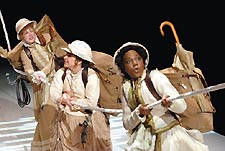
Recently, I read a thoroughly excellent play entitled "On the Verge." (see picture). Basic premise: three Victorian explorer women set out to explore "Terra Incognita," and end up travelling into the future. Highly recommended. It made me realize how many fantastic, delicious words ther are in the English language. There's a whole treasure trove of words out there just begging to be used!

Resolution #1: Polish up vocabulary.

In contrast, the show I just finished working on, columbinus, had a different sort of vocabulary. It was gritty and realistic and very rough, which was perfectly fitting for the show. The constant barrage of dirty words made me realize how pointless foul language is. Its only point is to shock and seek attention. But after you've been bombarded with those words thousands of times, they loose their power. But words like: incandescent, sunset, creamy, cerulean, ebullient, effervescent, melifluous, snowfall, sparkle, celestial, vibrant, beauty, quintessence, and love will always radiate beauty and meaning. That's what language is supposed to be.


Also, I was surprised by how much I identified with the character Mary (there are three main characters-Fanny, Mary, and Alexandra). Throughout the play, I never felt like I had a good sense of who Mary was, until the end. Half-way through the play, the women settle down in the 1950's. But Mary wants to travel on, she wants to find more and more adventures---"I have such a yearning for the future! It is boundless!" I love that spirit of adventure-it reminds me of that Chesterton quote: "An inconvenience is only an adventure wrongly considered, an adventure is an inconvenience rightly considered."

Resolution #2: Look on life as an adventure.


Finally, one of the big debates that exists in the play is whether or not the women should wear trousers. (Trousers! Shocked gasp.) Alexandra is all for it, Fanny is dead set against it, and Mary says: "The civilizing mission of Woman is to reduce the amount of masculinity in the world. Not add to it by wearing trousers." I would argue with Mary that we're not supposed to reduce the amount of masculinity, per se, but rather counter it with an equal amount of femininity. These three women are strong, gracious, and playful. Despite their idiosyncratic flaws, they're all admirable literary characters.

Resolution #3: Be a part of "On the Verge" someday, somehow, somwhere.

Monday, February 22, 2010

But the Flesh is Weak

I found this wonderful video through Modestia:


And here's the website:

http://loveyourflawz.com/

This is such an awesome reminder that we don't need to be "perfect" or anorexic or covered in hairspray, airbrushed makeup and WD-40 to be beautiful.

I was talking with a friend recently about beauty. Everyone has a unique beauty all their own.
God is an infinite source of Beauty, and He's poured His beauty into creation. Obviously, because creation is finite, it cannot possibly contain all His Beauty, but God's beauty manifests itself in each created thing-from the smallest flower to the tallest mountain. And, in an even more particular way, in us. God has an infinite amount of beauty, and He's given each of us our own particular way of sharing in His beauty. Each of us manifests the beauty of God in a singular way that no one else in this world possibly could. God has so much beauty to pour out into the world, how could He possibly create something or someone that lacks beauty?

It simply isn't possible.

"You may not think you're beautiful enough, but Someone does. And that Someone made sunsets."---A Wise Woman I Have the Privilege of Knowing

This is a lovely article I was sent this past week. It's from a blog called "To Write Love on Her Arms," and here's a little sneak preview:

In honor of National Eating Disorders Awareness week, we wanted to share a beautiful story written by a former TWLOHA intern, Stephanie Koszalka. Please read it and enjoy remembering that your life and your story are powerful. No self-determined imperfection can change that.

Dear Body,

I’ve always let some imperfection or another stand in the way of me seeing what you truly are, that you are beautiful. You are a divine creation housing the most valuable thing known to the universe, my soul. I’m beginning to realize that a person’s soul has the capacity to radiate light that transcends all the characteristics that I have been conditioned to believe are flaws.

Friday, February 5, 2010

Pan's Labyrinth

by Desi & Portia


"What happens when make-believe believes it's real?"


"You're getting older, and you'll see that life isn't like your fairy tales. The world is a cruel place. And you'll learn that, even if it hurts... Ofelia! Magic does not exist. Not for you, me or anyone else."

Or does it?

That is the question posed by Pan's Labyrinth. The film, by Guillermo del Toro, is a mystifying, captivating and beautiful work of art.

The narrator tells us at the beginning of the film:

A long time ago, in the underground realm, where there are no lies or pain, there lived a Princess who dreamed of the human world. She dreamed of blue skies, soft breeze, and sunshine. One day, eluding her keepers, the Princess escaped. Once outside, the brightness blinded her and erased every trace of the past from her memory. She forgot who she was and where she came from. Her body suffered cold, sickness, and pain. Eventually, she died. However, her father, the King, always knew that the Princess' soul would return, perhaps in another body, in another place, at another time. And he would wait for her, until he drew his last breath, until the world stopped turning...

We then meet Ofelia. The poor young girl's being dragged along with her pregnant mother to live with her stepfather, a captain in the Facist army. Ofelia does not actively hate her stepfather, she does not act maliciously towards him, but she refuses to call him papa. Her mother pleads with her, "It's just a word, Ofelia, just a word." but Ofelia knows it is not. There is a man who is her father, and she is his beloved princess. This man is not him. In her innocent youth, Ofelia refuses to tell such a blatant lie.

When Ofelia and her mother reach their new home, an outpost in the wooded mountains, Ofelia immediately discovers a labyrinth in the woods. And from there on out, Ofelia is swept up into other worldly adventures. And we ask ourselves: are they real or imaginary?


Is Ofelia a princess?

Are her adventures real or our they a product of her own imagination?

The movie is brilliant, yet brutal. While it is definitely a fantasy, no one could accuse it of being an escapist fantasy. The parallell worlds of the spiritual/mythological world that Ofelia ventures into, and the harshly real world of the Spanish rebellion are both cut-throat, dangerous places. Ofelia is the only person that we know is good. She is a protagonist that we cling to, because there's no one else to cling to.

For young children (and yes, even adults on occasion), imaginary worlds and make-believe are a definite escape from their problems-they're a release. If the faun is a product of Ofelia's imagination, he is a far from comforting one. While he appears to be a father-figure, a guardian to this princess lost in a cruel, foreign world, there's always a doubt in our hearts: Do we trust him? What makes Ofelia an extraordianry heroine is her innocence and her trust. She never doubts that what the faun tells her to do is for her own good. She trusts. I don't know if you can read it, but the poster above has a tagline at the bottom, which reads: "Innocence Has A Power Evil Cannot Imagine" Ofelia's innocence is her only weapon to combat the evil and cruelty around her.

"I've had so many names. Old names that only the wind and the trees can pronounce. I am the mountain, the forest and the earth. I am... I am a faun."

An interesting component in the film is the labyrinth. While "labyrinth" and "maze" are often used as synonyms, they mean and imply vastly different ideas. A maze is a human puzzle, as it were. You try to get from one end of the maze to the other-you are presented with choices: you can either choose to go to your left or to your right. One of these choices will lead you further on the right path, the other will lead you to a dead end.

But in a labyrinth, you only have one path. It leads you to the center, and then out again. You have no idea where you are going; you simply have to trust that you will make it to the middle, through the middle and then out again. That trust is a huge component of the film. Ofelia trusts the faun, she believes that she will get through this dark time in her life, and reach the kingdom she is destined for.

But can we really trust anyone?

And yet, what happens to us when we trust no one. We turn into a Captain Vidal. If we close ourself off from humanity, distrusting all our fellow men, we cease to become human. Ofelia battles bizzare and frightening monsters in her imaginary land. But the real monster is the man she refuses to call father; and she defeats him, though it costs her a terrible price.

Whether the labyrinth, the faun, and the magical world that Ofelia finds is real or not, it doesn't matter. Ofelia wins. She has the power of an innocent, which is unfathomable to those twisted and soured by their own hardened hearts. The blood she spills has the power to open the portal-she joins her mother and father, and spends an eternity by their sides. What more has she ever wanted?

"In darkness, there can be light. In misery, there can be beauty. In death, there can be life...."
G.K. Chesterton writes that "there are some who cannot see a simple truth without calling it a paradox." Paradoxes are beautiful, because they are the Truth. How can God be both God and Man? Yet He is. How can there be Life in Death? How can some something be both Real and yet Not-Real?
Yet they are. Paradoxes are the fabric of our universe-and they are beautiful. The Truth is inscrutably and piercingly simple, and yet it is a beautiful, unfathomable mystery.


Wednesday, February 3, 2010

Truth is Beauty

"As soon as we begin to explicate the poem, analyze the picture, classify the architecture or dissect the music we lose what we were enchanted by, and it is this enchantment through beauty which matters....Why should we take time and spend money to make our churches beautiful, our liturgy beautiful, our music beautiful, our art beautiful? Because it is through this beauty that we are taken into the heart of the divine order of all things. This is so difficult to communicate in a world of useful things. We have come to regard beautiful things as only so much luxurious ornamentation. We regard expenditure on beauty as wasteful--boors that we are--but this is not only boorish, it is spiritually bereft."

Fr. Longenecker on why churches should be beautiful.